Why Classic Vector RAG Hits a Wall If you have shipped a RAG pipeline to production, you have already found its edges. Your retrieval works well when a user asks a loose semantic question over a homogeneous corpus, and it quietly falls apart everywhere else.
The root issue is that embeddings are approximation engines. They prioritize semantic closeness, which means exact-match queries—error codes, product SKUs, version numbers—frequently return the wrong chunk or nothing at all [4]. A user asking for the release notes of v3.14.2 does not want a semantically similar paragraph about release process philosophy; they want the exact text. BM25 would find it; your embedding model will not.
Single-pass retrieval compounds this problem for agents. When a question requires chaining evidence across multiple documents—"What was the revenue impact of the contract clause introduced in Q2?"—a single embed-and-search step cannot construct that chain. The agent gets one batch of top-k chunks and has no mechanism to recognize the answer is incomplete or to re-query with a refined hypothesis [4].
There is also a cost problem specific to agentic workloads. As your agent's capability grows, so does its tool catalog. Injecting the full list of tool descriptions into every LLM call is expensive and degrades accuracy as context lengthens [3]. Classic RAG offers no answer to this; it simply passes everything to the model every time.
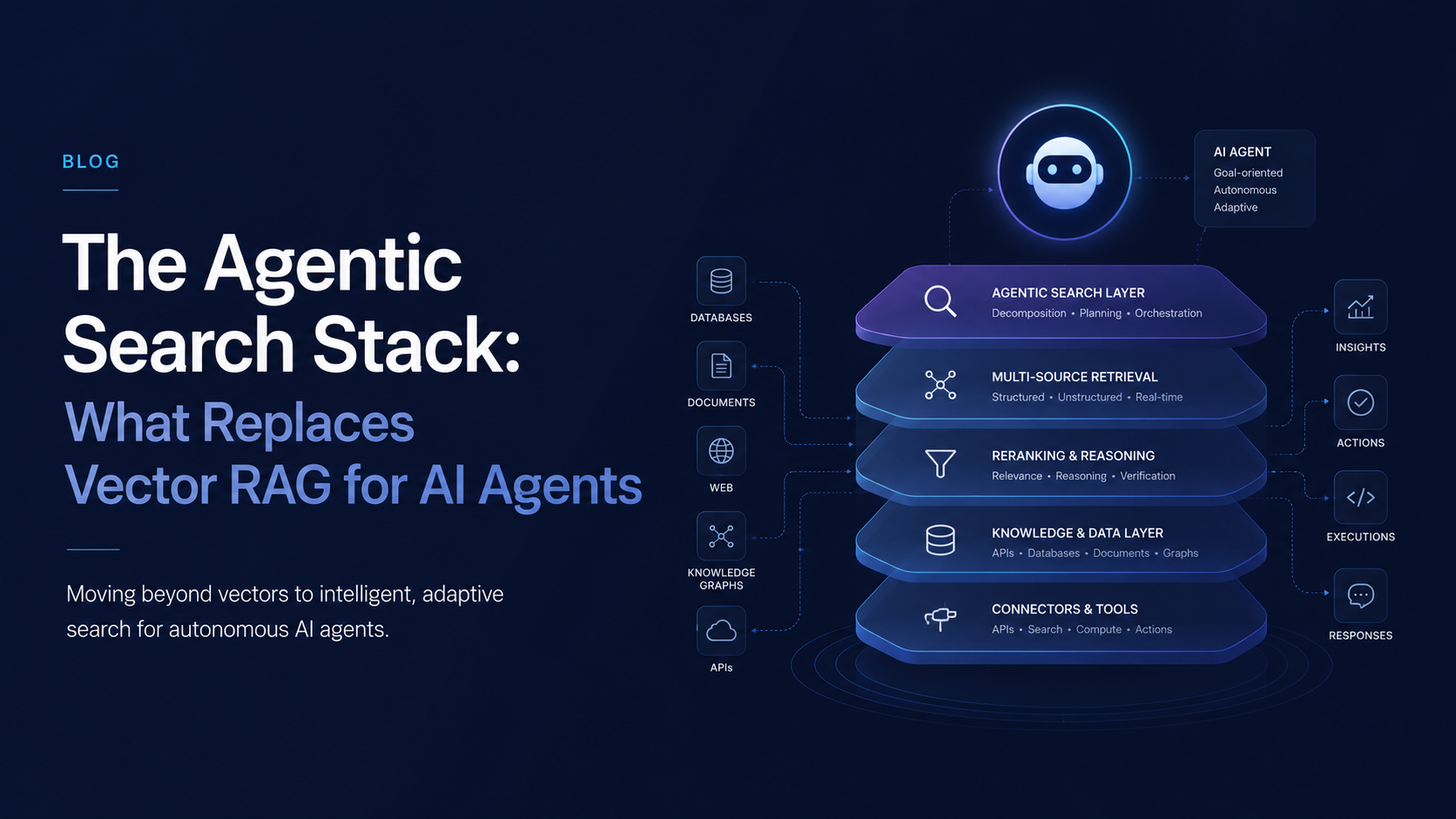
Anatomy of the Agentic Search Stack The shift away from single-pass vector retrieval is not one new technique—it is a layered stack that replaces each component of the old pipeline with something purpose-built for agents.
At the foundation, hybrid search replaces pure vector similarity. You run BM25 and dense retrieval in parallel, then fuse the result sets using Reciprocal Rank Fusion (RRF), which merges ranked lists by position rather than raw score [4]. This single change captures both lexical precision and semantic breadth, and for most workloads it is the highest-leverage upgrade available.
Above the retrieval layer sits the agentic loop. Instead of retrieve-once-and-answer, the agent follows a plan–retrieve–grade–re-plan cycle: it formulates sub-queries, retrieves evidence, scores the evidence for sufficiency, and re-queries with a refined plan if the grader finds gaps [2]. This loop is what turns a retrieval system into a reasoning system. By end-2025, production systems like RAGFlow had repositioned themselves as Agentic Context Engines that orchestrate knowledge, memory, and tool calls together—rather than pipelines that simply surface similar text [8].
Query decomposition and source routing add another degree of freedom. The agent breaks a complex question into sub-queries and dynamically selects the appropriate retrieval mode for each one—vector index, keyword search, SQL, a REST API, or live web search—rather than routing everything to a single vector store [2]. Federated retrieval then combines results across heterogeneous corpora without querying every index for every request, cutting latency and cost [2].
The result is a stack where vector search is one tool among several, invoked when semantic similarity is genuinely the right signal, rather than the default answer to all retrieval problems.
Graph-Based Retrieval and Structured Knowledge Bases For queries that require multi-hop reasoning—tracing a causal chain, mapping dependencies, or running compliance analysis across a document corpus—flat vector indexes are structurally insufficient. You need something that understands relationships, not just similarity.
GraphRAG addresses this by extracting entities and relationships from your documents into a knowledge graph. Agents can then traverse causal chains and synthesize information across documents that vector similarity would miss entirely [6]. The key difference from vector search is structural: you are following typed edges between named entities, not comparing floating-point vectors. This is what enables tasks like "find all contracts that reference Supplier X and contain a force-majeure clause"—a query that requires relationship traversal rather than semantic lookup [6].
In an agentic context, GraphRAG also functions as a stateful memory layer. Rather than treating retrieval as a stateless lookup, the agent acts as a router: vector search for simple factual queries, graph traversal for relationship-heavy or multi-step reasoning tasks [6]. The routing decision is made at query time based on query complexity, not hardcoded.
Structured knowledge bases provide a complementary capability. Azure AI Search's agentic retrieval model, for example, separates knowledge sources—which can be search indexes, blobs, or SharePoint sites—from knowledge bases, which are higher-level service objects that orchestrate multi-step retrieval across those sources [7]. You trigger a retrieve action on the knowledge base, pass knowledge source references and an AI model config for query planning, and the system handles the decomposition and fusion [7]. This architecture gives you a stable, auditable layer of structured ground truth that ephemeral embedding indexes cannot guarantee across document updates.
Memory Layers and Tool-Augmented Retrieval Retrieval covers what the agent finds at query time. Memory covers what the agent retains and reuses across turns and sessions—a distinction that classic RAG erases entirely.
Production agentic systems now maintain at least three memory types: semantic memory for durable facts, episodic memory for interaction history and user preferences, and working memory for the current reasoning context [8]. These layers come with lifecycle management: indexing, summarization, and intentional forgetting that prunes stale or irrelevant state [8]. Building this yourself from scratch is non-trivial; treating it as an afterthought guarantees the agent repeats itself, loses context, and degrades in multi-turn settings.
Tool-augmented retrieval solves the catalog-size problem mentioned earlier. Rather than injecting every available tool description into the model's context, you store tool descriptions as vectors in object storage, run similarity search over the catalog for each incoming request, and surface only the most relevant tools to the LLM [3]. The result is a leaner context window, lower token costs, and—counterintuitively—higher accuracy, because the model is not distracted by irrelevant tool options [3].
For live-web retrieval, a 2026 AIMultiple benchmark evaluated eight search APIs across 100 real-world agent queries and found that Brave Search, Firecrawl, Exa, and Parallel Search Pro are statistically tied in output quality [5]. Brave Search recorded the highest numerical score at 14.89 and the lowest latency at 669 milliseconds [5]. The practical takeaway is that the APIs are close enough that query type should drive selection: Firecrawl excels at deep full-page content extraction, Exa uses neural embeddings for semantic discovery, and Brave is optimized for low-latency live web retrieval [5]. Match tool to query type rather than picking one API for all retrievals.
Trade-offs, Failure Modes, and When to Keep RAG The agentic stack is not unconditionally better than vector RAG. Every additional component is a latency budget and a maintenance surface, and neither is free.
Multi-step plan–retrieve–grade cycles add round-trips that single-pass vector search does not incur. For latency-sensitive, high-volume workloads, the per-query cost of multiple LLM calls and retrieval steps can outweigh the accuracy gains. Knowledge graphs also require ongoing maintenance: as source documents change, entity extractions and relationship mappings must be refreshed or the graph diverges from ground truth [6].
The accuracy numbers are genuine but context-dependent. AgenticRAG's multi-step retrieval on the FinanceBench dataset reaches 92% answer correctness, within 2 percentage points of oracle-evidence performance [1]. That is a strong result, but it is measured on long-form enterprise financial documents—exactly the corpus where compositional multi-hop retrieval shines. For simple, factual, single-document queries, optimized hybrid RAG will outperform full agentic orchestration on cost-per-query while delivering comparable accuracy.
The honest engineering decision is a spectrum, not a binary. Start with your query distribution. High compositional complexity, cross-document reasoning, or compliance requirements push you toward the full stack. High query volume over a homogeneous corpus with straightforward lookups probably does not justify the orchestration overhead [1].
A Practical Migration and Decision Framework You do not need to rebuild everything at once. The following order of operations applies to most production agent systems.
Step 1: Upgrade to hybrid retrieval. Replace pure vector search with parallel BM25 + dense retrieval fused via RRF [4]. This is the single highest-leverage change available and requires no architectural overhaul—just a new retrieval layer and a reranker. Most practitioners see immediate gains on exact-match and keyword-heavy queries.
Step 2: Add a retrieval grader and re-query loop. Before you invest in graph infrastructure, instrument your retrieval step with a grader that evaluates whether retrieved evidence is sufficient to answer the sub-query [2]. If it is not, the agent re-queries with a refined decomposition. This alone captures the majority of multi-hop accuracy gains at much lower complexity than building a full knowledge graph.
Step 3: Adopt structured knowledge bases and GraphRAG for relationship-heavy workloads. If your agents need to traverse entity relationships, perform compliance analysis, or answer queries that span documents through causal chains, add a knowledge graph layer and configure a structured KB that separates sources from orchestration logic [7]. Route queries through the complexity-based router: vector for fact lookups, graph for relationship traversal [6].
Step 4: Implement tool-selector retrieval. As your tool catalog scales past a handful of tools, store tool descriptions as vectors and retrieve the relevant subset per request rather than injecting the full catalog [3]. Pair this with your memory layer so the agent maintains context across a session without re-discovering the same tools on every turn [2].
The net result is a system where vector search is still present—it is still good at what it does—but it is no longer the entire retrieval stack. It is one tool among several, invoked when semantic similarity is the right signal, routed past when it is not.
Sources AgenticRAG: Agentic Retrieval for Enterprise Knowledge Bases — arxiv.org (https://arxiv.org/html/2605.05538v1) 6 agentic knowledge base patterns emerging in the wild — thenewstack.io (https://thenewstack.io/agentic-knowledge-base-patterns/) Optimize Agent Tool Selection Using Amazon S3 Vectors and Amazon Bedrock Agents — aws.amazon.com (https://aws.amazon.com/blogs/storage/optimize-agent-tool-selection-using-s3-vectors-and-amazon-bedrock-agents/) Why Vector Search Alone Isn't Enough: Hybrid Retrieval for RAG — infoq.com (https://www.infoq.com/articles/vector-search-hybrid-retrieval-rag) Agentic Search in 2026: Benchmark 8 Search APIs for Agents — aimultiple.com (https://aimultiple.com/agentic-search) Beyond Vectors: GraphRAG & Agentic AI for Smarter Knowledge Retrieval — 2025.allthingsopen.org (https://2025.allthingsopen.org/sessions/beyond-vectors-graphrag-agentic-ai-for-smarter-knowledge-retrieval) Create a Knowledge Agent — Azure AI Search Agentic Retrieval — learn.microsoft.com (https://learn.microsoft.com/en-us/azure/search/agentic-retrieval-how-to-create-knowledge-agent) From RAG to Context — A 2025 Year-End Review of RAG — ragflow.io (https://ragflow.io/blog/rag-review-2025-from-rag-to-context)
FAQ
What is the Agentic Search Stack?
The Agentic Search Stack is a layered architecture for AI agents that combines hybrid retrieval, query decomposition, grader-driven re-query loops, knowledge graphs, and memory layers to enable multi-step reasoning and tool orchestration.
How does it differ from classic vector RAG?
Unlike single-pass vector RAG, the stack fuses lexical and dense retrieval, decomposes queries, scores evidence, re-queries when needed, and routes queries to graphs or APIs—turning retrieval into active reasoning rather than one-shot lookup.
When should I use GraphRAG or a knowledge graph?
Use GraphRAG for relationship-heavy, multi-hop, or compliance queries that require traversing entity links across documents—cases where similarity alone cannot reconstruct causal or dependency chains.
How do I migrate from vector RAG to an agentic stack?
Migrate incrementally: (1) switch to hybrid BM25 + dense retrieval with RRF, (2) add a retrieval grader and re-query loop, then (3) introduce structured knowledge bases and GraphRAG only where relationship traversal is required.
What are the main trade-offs of adopting the agentic stack?
The agentic stack boosts accuracy on complex queries but increases latency, engineering overhead, and maintenance cost (e.g., graph curation); for simple, high-volume lookups, optimized hybrid RAG may be more cost-effective.