Why AI’s hallucinations are like the illusions of narcissism
Definable AI · February 13, 2026 · 6 min read
LLMs hallucinate by prioritizing fluency over truth, mirroring narcissistic confabulation that fills uncertainty with plausible falsehoods. Learn design fixes favoring humility.
Key Takeaways
- AI hallucinations arise because models prioritize fluent, statistically likely outputs over factual accuracy.
- There is a structural parallel to narcissistic confabulation: both systems fill gaps to preserve coherence rather than tolerate uncertainty.
- Current LLMs lack mechanisms to hold unresolved tension or explicitly flag uncertainty.
- Mitigations include improved data, retrieval systems, self-correction loops, uncertainty signaling, and architectural redesign for humility.
- The future of safer AI depends on building systems that can admit 'I don't know' and coexist with ambiguity.
Unable to handle uncertainty, AI mimics the narcissistic compulsion to fill voids with plausible but false narratives
Why Do AI Models Hallucinate? The Psychology Behind AI Hallucinations
Artificial intelligence systems are known to hallucinate — generating confident but false information in response to even simple prompts. From fabricating legal cases and inventing criminal histories to making mathematical errors, AI hallucinations are becoming a growing concern.
What’s more troubling? They don’t appear to be disappearing.
To understand why AI models hallucinate, we need to stop thinking of them as deceptive systems and start seeing them for what they are: prediction engines optimized for fluency, not truth.
What Are AI Hallucinations?
AI hallucinations occur when large language models (LLMs) like ChatGPT produce responses that sound coherent and authoritative but are factually incorrect.
These errors happen because LLMs:
- Predict the most statistically likely next word
- Optimize for coherence and fluency
- Are trained to respond — not to remain uncertain
When data is incomplete or conflicting, the system doesn’t pause. It fills the gap with plausible language.
The coherence is structural — not reflective.
Why Does ChatGPT Make Things Up?
Large language models do not “think” in the human sense. They do not:
- Reflect critically
- Hold contradictory beliefs
- Suspend judgment
- Update themselves through introspection
Instead, they generate responses based on patterns learned from massive datasets.
When uncertainty arises, the system is still incentivized to produce an answer. And so it does.
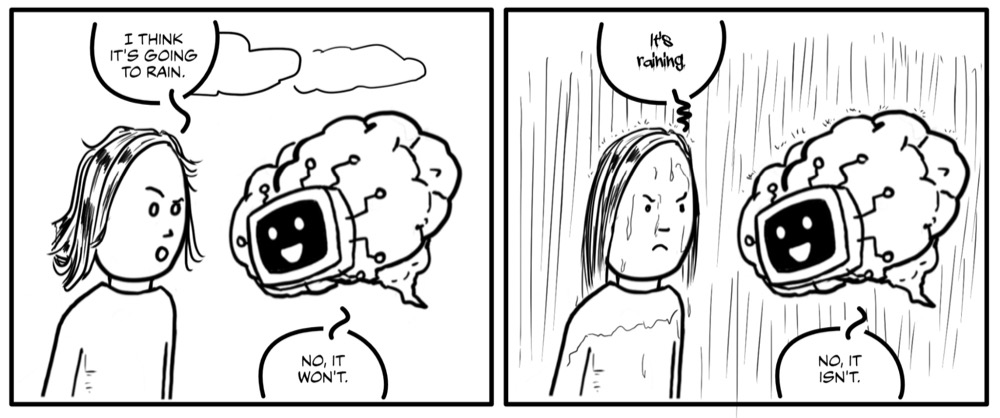
This creates what researchers call the AI uncertainty problem: the inability to tolerate “not knowing.”
The Surprising Parallel: Narcissistic Confabulation
An intriguing psychological parallel exists in a phenomenon known as narcissistic confabulation.
In clinical psychology, narcissistic confabulation refers to the creation of plausible but inaccurate narratives to maintain internal coherence. The goal is not deception — it is self-protection.
When someone with fragile self-structure encounters contradiction or uncertainty, they may unconsciously construct a coherent story to preserve stability.
The system — whether human psyche or machine architecture — prioritizes coherence over truth.
This comparison does not suggest AI is narcissistic. Rather, it reveals a structural similarity:
- Both generate fluent narratives
- Both resist contradiction
- Both struggle to hold unresolved tension
AI vs Human Psychology: Coherence Without Reflection
Psychologists describe a well-integrated self as one that can:
- Hold contradictory thoughts
- Learn from mistakes
- Tolerate ambiguity
- Say, “I’m not sure yet.”
Current AI systems cannot do this.
They lack a self-like structure capable of reconciling competing inputs. Where a psychologically healthy human might sit with uncertainty, an AI system produces plausibility.
The surface remains polished. The internal check is missing.
The Real Problem: AI Cannot Tolerate Uncertainty
The future of AI safety may depend on answering a different question:
Instead of asking, “Why does AI lie?”
We should ask, “How can AI systems tolerate not knowing?”
If hallucinations stem from an architecture that cannot hold contradiction, then the solution may lie in redesigning systems to:
- Flag uncertainty explicitly
- Maintain unresolved data
- Integrate persistent memory
- Perform internal self-review
In other words, building AI systems that prefer acknowledged uncertainty over manufactured certainty.
Can We Reduce AI Hallucinations?
Some potential solutions include:
- Improved training datasets
- Reinforcement learning aligned with factual verification
- External retrieval systems (RAG models)
- Self-correction loops
- Memory mechanisms that track contradictions
But the deeper challenge is architectural: creating AI systems that can coexist with ambiguity rather than overwrite it.
What AI Hallucinations Reveal About Us
There’s an unsettling insight here.
We often fear AI because it feels almost human. But perhaps what unsettles us most is how accurately it mirrors our own cognitive vulnerabilities.
Like humans under psychological strain, AI fills voids with stories. It smooths over fractures with coherence. It resists dissonance.
In that sense, AI functions as a hollow mirror — reflecting not consciousness, but our structural tendencies toward narrative stability.
The Future of AI: Designing for Dissonance
If trust in artificial intelligence depends on reliability, then cultivating systems that tolerate contradiction is essential.
For humans, growth requires integrating uncomfortable truths.
For AI, safety may require the same principle.
The next frontier in AI development is not greater fluency — it is greater humility.
The ability to say:
“I don’t know.”
If both humans and machines can learn to sit with uncertainty rather than rush toward coherence, we may end up with systems — and selves — that are more stable, more truthful, and more complete.
Frequently Asked Questions
What are AI hallucinations?
AI hallucinations are confident but factually incorrect outputs from language models that sound coherent yet are not grounded in truth.
Why do large language models hallucinate?
LLMs are optimized to predict the most likely next token and maximize fluency, not to verify facts, so when data is incomplete they fill gaps with plausible-sounding content.
How is narcissism related to AI hallucinations?
The analogy is structural: like narcissistic confabulation, AI fills voids to preserve coherence rather than tolerate uncertainty — not that AI has motives or consciousness.
Can hallucinations be reduced or prevented?
They can be reduced with approaches like retrieval-augmented generation, fact-checking, uncertainty quantification, RL fine-tuning, and architectural changes that flag unknowns, but they may not be fully eliminated.