In today’s offices worldwide, generative AI tools (from ChatGPT to AI-driven analytics) are fueling both excitement and unease. Many surveys show employees worry about AI replacing human jobs. A February 2025 Pew survey found 52% of U.S. workers are worried about AI’s impact at work, with 32% expecting fewer job opportunities for themselves. Similarly, an August 2025 Reuters/Ipsos poll found 71% of Americans feared AI would put “too many people out of work permanently.” Globally, Mercer’s 2026 survey reports that 40% of workers now fear losing their job to AI, up from 28% just two years ago. Such statistics underscore a growing AI job anxiety in the workforce.
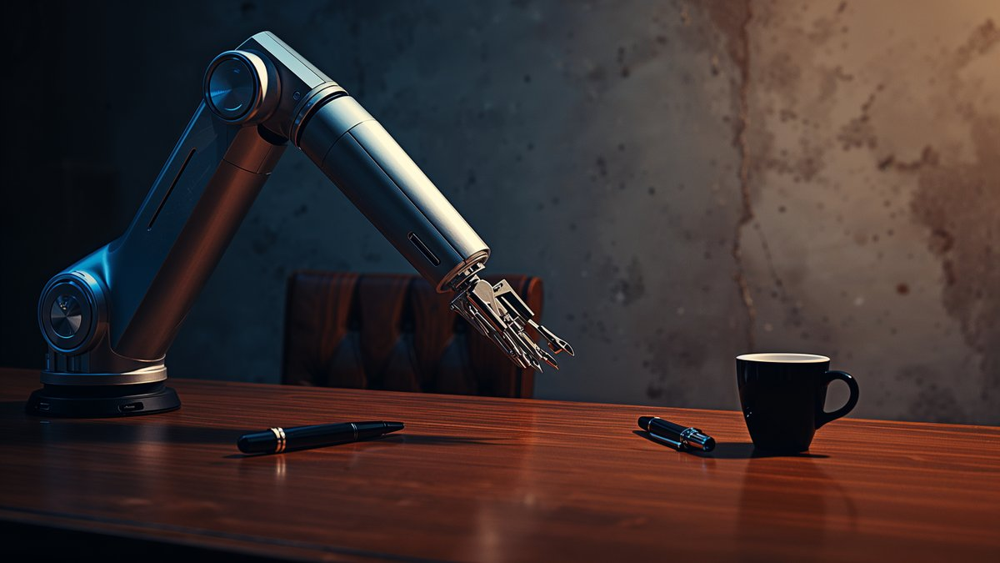
Figure: A robot-like machine in an office symbolizes growing workplace automation. AI’s human-like traits (anthropomorphism) and personalization capabilities can heighten employee fears of being replaced.
Recent research helps explain these fears. A 2025 study of office workers found that when AI systems feel personalized or “human-like,” employees are more anxious about being replaced. In contrast, AI characteristics like raw “self-learning” ability or memorability did not significantly raise fears. Notably, workers who are more skeptical of AI tend to be less anxious. In short, AI that seems familiar or intelligent (with a name, voice, or tailored output) can be more unsettling than purely technical features.
Moreover, AI job anxiety has real consequences for employees’ well-being. A 2025 study found that higher AI anxiety among service-sector employees significantly decreased their life satisfaction. Those who feared AI loss of control felt more negative emotions at work. Conversely, social support and training can buffer this effect. In practice, HR experts note that anxious workers report twice the stress and are more likely to be job-hunting. This highlights why organizations must address AI-related fears proactively.
Generative AI and Workplace Automation Trends§
AI adoption is booming across industries, reshaping tasks and roles. By 2025, reports show 78% of organizations use AI in at least one business function, and 71% have deployed generative AI tools. AI is no longer an experiment; it’s embedded in recruitment, content management, customer service, and more. In fact, many technology leaders expect generative AI to expand their teams – not shrink them – as workers focus on higher-value tasks.
Key Workplace Automation Trends:§
- Wage and productivity growth: Industries most exposed to AI enjoy twice-as-fast wage growth and 3× higher revenue-per-employee growth than others.
- Task automation: Generative AI could disrupt 50% of tasks in over 30% of occupations.
- Rise of AI tools: 16% of workers currently use AI tools weekly, and many say AI makes them work faster.
These trends clearly benefit productivity but also increase fears about job stability.
Why Workers Feel Anxious: Personalization, Anthropomorphism, and Skepticism§
Beyond statistics, psychological factors shape AI job fears.
1. Personalization§
AI tools that adapt closely to individuals (e.g., personalized assistants) make workers feel more replaceable. When software mirrors your style and decisions, it feels like a substitute rather than support.
2. Anthropomorphism§
Human-like AI traits—names, voices, avatars, conversational tone—heighten job replacement anxiety. When AI seems “human,” employees perceive it as direct competition.
3. Skepticism§
Interestingly, employees who are skeptical about AI capabilities often experience lower anxiety. Doubt can reduce perceived threat.
Research suggests employees evaluate AI through three psychological needs:
- Competence
- Autonomy
- Relatedness
If AI threatens these needs, resistance increases. If it supports them, adoption improves.
Impact on HR, Marketing, CMS, and Tech Teams§
AI for HR§
AI tools automate resume screening, onboarding queries, performance analytics, and recruitment workflows. While efficiency improves, 31% of global workers report fear of AI replacing them. However, many HR professionals are pivoting toward AI governance, analytics oversight, and workforce strategy.
AI for Marketing and Content Teams§
Generative AI creates blog drafts, ad copy, social captions, and personalized campaigns. Marketing professionals now:
- Use AI for ideation
- Analyze customer data faster
- Optimize SEO strategies at scale
Rather than replacing marketers, AI shifts focus toward strategy, creativity, and brand storytelling.
AI for Tech Professionals§
Developers leverage AI coding assistants to accelerate software production. While some backend tasks are automated, AI expands opportunities in:
- AI integration
- Prompt engineering
- Automation architecture
- Ethical AI compliance
AI in CMS and Content Management§
Content teams use AI-powered CMS systems for:
- Auto-generating product descriptions
- Knowledge base automation
- Multilingual content scaling
This increases productivity but demands stronger editorial oversight.
Addressing AI Job Anxiety in the Workplace§
Organizations can reduce generative AI job anxiety through:
Transparent Communication§
Explain clearly how AI will be used and what roles will evolve.
Upskilling Programs§
Offer training in:
- AI literacy
- Prompt engineering
- Data analytics
- Automation management
Human-Centered AI Strategy§
Involve employees in AI deployment decisions.
Balanced Automation§
Use AI to augment, not replace, human strengths.
FAQs – People Also Ask§
Will AI replace human jobs?§
AI will automate tasks, not entire professions. Human skills like creativity, empathy, and leadership remain irreplaceable.
How is ChatGPT used in the workplace?§
ChatGPT assists with drafting emails, research, coding help, content creation, and customer interaction automation.
What is AI job anxiety?§
AI job anxiety is the fear that artificial intelligence will reduce job security or eliminate roles.
How can companies reduce AI fear among employees?§
Through transparency, reskilling initiatives, and clear communication about AI’s supportive role.
Conclusion: The Future of Work with Generative AI§
Generative AI is reshaping industries worldwide. While fears of AI replacing human jobs are rising, evidence shows AI often enhances productivity and creates new opportunities.
The key question is not whether AI will change the workforce—it already is. The real question is how organizations will adapt.
HR leaders, marketing teams, CMS professionals, and tech experts must:
- Embrace AI literacy
- Invest in workforce development
- Promote human-AI collaboration
By doing so, companies can transform AI job anxiety into competitive advantage.
FAQ
Will AI replace human jobs?
AI is likely to automate many tasks but not entire professions; human skills like creativity, empathy, and leadership remain essential and often shift roles toward higher-value work.
Why does personalization or anthropomorphism increase job fear?
When AI mirrors a worker’s style or appears human-like (name, voice, avatar), it feels like a direct substitute, which raises perceptions of replaceability and heightens anxiety.
How can employers reduce AI-related job anxiety?
Use transparent communication, involve employees in AI deployment, offer reskilling/upskilling programs, and design AI to augment rather than replace human roles.
Does AI adoption lead to net job losses or gains?
Evidence shows both displacement of routine tasks and creation of new roles; many organizations report productivity gains and role shifts toward AI governance, prompt engineering, and strategy.