How to manage work as HR using DefinableAI
Definable Team · April 3, 2026 · 11 min read
Cut HR tool sprawl and the toggle tax by unifying hiring, knowledge, branding, and automation with Definable AI. Save costs and automate core HR workflows.
Key Takeaways
- Tool sprawl costs HR teams ₹17,000+ per user/month and creates a productivity 'toggle tax'.
- A unified AI workspace consolidates writing, branding, knowledge, and automation into one affordable subscription.
- RAG-powered Knowledge Base delivers accurate, document-sourced answers and reduces repetitive HR queries.
- AI Agents execute end-to-end workflows—resume screening, onboarding, scheduling, and compliance tracking—freeing HR for strategic work.
- Creative tools like Photo Studio and multi-model chat centralize employer branding and nuanced HR communications.
The HR Tool Stack is Costing You More Than You Think
Here's a quiet financial leak hiding in most HR departments.
You have a writing assistant for job descriptions and emails. A separate design tool for employer branding. An AI chatbot for internal FAQs. A sourcing platform for recruitment. Each one seemed like a smart, modern addition when it was purchased.
But add them up and you're looking at ₹17,000+ per user, per month — before factoring in the productivity drain of jumping between five different interfaces, managing five different logins, and hoping five different datasets ever agree with each other.
This is "tool sprawl" — and it's the silent budget killer of the modern HR department.
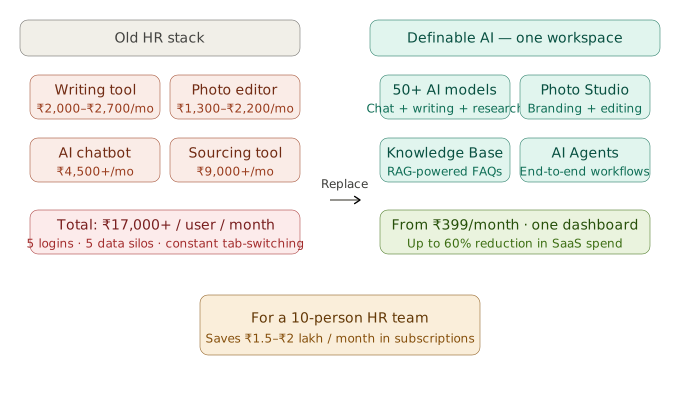
What Tool Sprawl Actually Costs HR
The financial cost is the visible part. The hidden cost is what the industry calls the toggle tax — the accumulated productivity loss from context-switching between platforms all day.
The traditional HR AI stack breaks down like this:
| Tool | Monthly Cost (Per User) |
|---|---|
| Writing assistant (emails, posts, JDs) | ₹1,800–₹2,700 |
| Design / photo editor for branding | ₹1,300–₹2,200 |
| AI chatbot / knowledge base | ₹4,500+ |
| Recruitment sourcing tool | ₹9,000+ |
| Total | ₹17,000+ per user |
And that's before seat licenses for team members who only occasionally need access. Each tool's per-seat model means you're paying for access, not usage. For a 10-person HR team, switching to a unified platform like Definable AI can save ₹1.5–₹2 lakh per month.
Why Fragmented HR AI Fails at Scale
The tools work individually. The system breaks down.
Traditional HR automation — whether basic RPA, digital forms, or point AI tools — shares the same structural weakness: it automates fragments of a process while leaving humans to bridge the gaps between systems. Your HRIS triggers onboarding, but IT still manually creates access tickets. Your chatbot answers some FAQ questions but escalates everything else to an overwhelmed inbox.
At enterprise scale, this patchwork approach produces predictable outcomes: backlogs grow, response times slow, compliance tracking becomes manual, and the promise of automation falls short. The problem isn't that the individual tools are bad. The problem is that they don't talk to each other — and HR processes rarely live inside one system.
The Architecture of a Modern AI-Powered HR Department
The shift from fragmented tools to a unified AI workspace isn't just about consolidation. It's about giving HR teams a system where intelligence flows across all functions from a single interface.
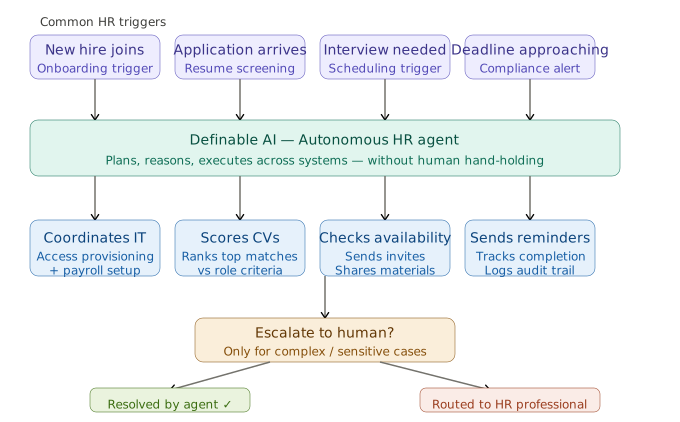
In a unified workspace, a single platform handles what previously required five subscriptions — multi-model AI chat replaces the writing assistant, Photo Studio replaces the design tool, Knowledge Base replaces the standalone chatbot, and AI Agents replace manual workflows. One login, one dashboard, one data layer, zero toggle tax.
How Definable AI Transforms HR Operations
Definable AI is built specifically as this unified workspace — India's first all-in-one AI platform combining 50+ AI models, a creative studio, video tools, an automation layer, and a knowledge base under a single affordable subscription starting at ₹399/month.
1. Multi-Model AI Chat: From Writing Tool to Strategic Partner
Instead of paying for a single-purpose writing assistant, Definable AI gives HR teams access to 50+ large language models in one interface. Different AI models excel at different HR writing tasks.
The practical implication is significant:
- Use Claude for sensitive internal communications that require empathy and nuance — redundancy announcements, disciplinary communications, sensitive policy updates
- Use GPT-4o for policy drafts that demand logical precision and consistency
- Use deep research mode for benchmarking compensation, researching employment law updates, or analysing employee engagement trends
HR writing tasks handled in one place include job descriptions optimised for different platforms, interview question banks tailored to specific roles, performance review frameworks and feedback templates, sensitive internal memos, employer branding copy for LinkedIn and career pages, and onboarding welcome communications. All from one interface. No tool-switching.
2. Knowledge Base (RAG): The End of "Where is the PDF?"
This is the feature that transforms HR operations most visibly for employees.
Every HR department maintains a library of critical documentation: the employee handbook, leave policies, benefits information, PF and insurance details, compliance guidelines, appraisal frameworks. In most organisations, this knowledge is either locked in a shared drive no one can navigate, or answered (slowly) by an overworked HR coordinator.
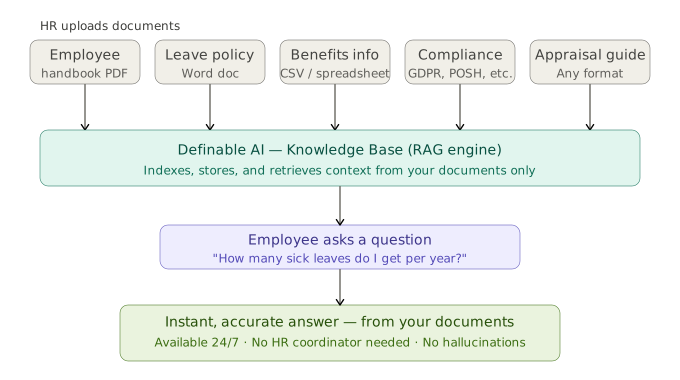
Definable AI's Knowledge Base feature lets HR teams upload this documentation — PDFs, Word documents, CSVs, spreadsheets — and convert it into an intelligent, always-on internal resource.
The outcome is a conversational interface that answers employee queries accurately and instantly, sourced only from your company's actual documents. It handles questions in natural language ("What's the policy on work from home for new joiners?"), handles questions 24/7 across time zones, and eliminates the FAQ backlog that consumes HR coordinators' mornings.
The technical architecture is Retrieval Augmented Generation (RAG) — the AI doesn't guess or hallucinate answers, it retrieves the relevant section of your uploaded document and generates a precise, contextual response.
For HR specifically, this means:
- New joiners can self-serve onboarding information without waiting
- Employees in different geographies get location-correct policy answers automatically
- HR coordinators are freed from repetitive Q&A to focus on strategic and sensitive work
- Compliance-sensitive queries (leave encashment, gratuity, POSH policy) are answered from verified documentation only
3. AI Agents: Your Always-On HR Workforce
AI chat and knowledge bases handle communication. AI agents handle execution.
This is the distinction most tools miss. A chatbot answers questions. An AI agent completes tasks — autonomously, across systems, at scale, without requiring a human to supervise each step.
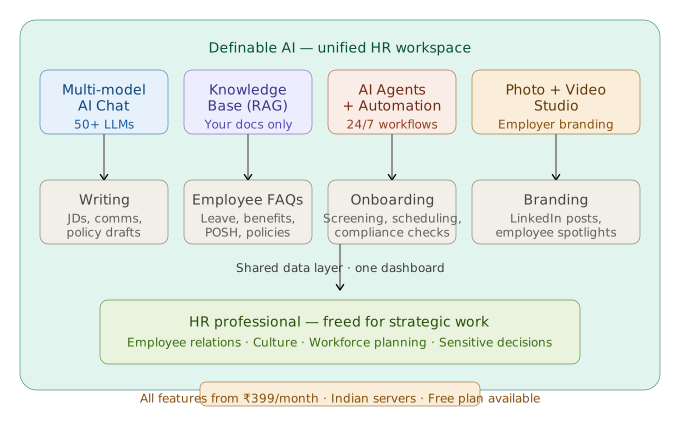
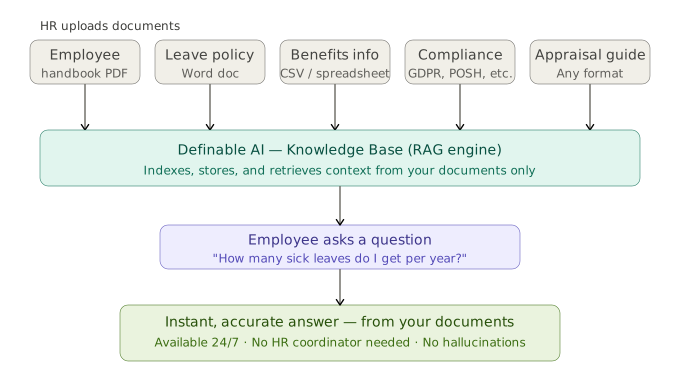
Definable AI's AI Agent capabilities allow HR teams to deploy purpose-built agents that run workflows end-to-end:
Resume Screening Agent scans incoming applications against defined role criteria, scores candidates, and surfaces top matches — without a recruiter manually reading every CV. Reduces time-to-shortlist from days to minutes for high-volume roles.
Onboarding Coordination Agent triggers the full onboarding workflow from a single input — coordinating across IT for access provisioning, finance for payroll setup, facilities for equipment, and HR for documentation collection. No inter-department email chains.
Policy Compliance Reminder Agent monitors completion of mandatory training, policy acknowledgements, and compliance deadlines. Sends proactive reminders with context and tracks completion — without HR manually chasing each employee.
Interview Scheduling Agent coordinates availability between candidates and interview panels, sends calendar invites, shares preparation materials, and handles reschedules — all without HR coordinator involvement.
Employee Support Agent handles Tier-1 HR queries (leave balance, payslip requests, policy clarifications) autonomously, escalating only the genuinely complex or sensitive cases to a human HR professional.
The business case is direct: tasks that previously consumed 60–70% of an HR coordinator's working week can be handled by agents running in the background. HR professionals shift from processing requests to work that actually requires human judgment.
4. Photo Studio: Employer Branding Without an Agency
Employer branding is a continuous, visual discipline — and it's been expensive.
Definable AI's Photo Studio brings cinema-grade image generation and editing directly into the HR workspace:
- Transform casual mobile photos into professional LinkedIn employer branding posts
- Generate professional profile-quality visuals for employee spotlights
- Create consistent visual assets for job postings across platforms
- Build onboarding welcome imagery and team introduction materials
Key features used by HR teams include AI relighting (making any photo look professionally lit), face swap (standardising images for ID cards or profiles), in-painting (removing distracting backgrounds), and persistent character creation (maintaining visual consistency across a campaign).
No external designer required. No separate design subscription. No waiting two weeks for an agency brief.
The Business Case: What the Numbers Say
Switching to a unified AI workspace for HR produces compounding savings:
Direct subscription savings: Replacing 4–5 separate tools with a single Definable AI subscription at ₹399/month eliminates ₹15,000–₹20,000+ per user per month in combined SaaS costs. For a team of 10 HR professionals, that's ₹1.5–₹2 lakh saved monthly.
Productivity recovered from toggle tax: Reducing context-switching across five platforms recovers meaningful hours per week per HR professional. At scale, this compounds into full-time equivalents reclaimed for strategic work.
Response time for employee queries: AI-powered Knowledge Bases reduce response time for standard HR queries from hours (or days) to seconds. Employee experience improves. HR credibility improves.
HR teams on Definable AI are seeing:
- Up to 60% reduction in monthly software spend
- Zero toggle tax — everything in one dashboard
- Future-proofed access — new AI models are added automatically, without additional subscriptions
The Strategic Shift: From Administrative HR to Strategic HR
The most important outcome isn't financial. It's what HR teams do with the time and cognitive capacity they recover.
IBM's internal AI deployment automated more than 80 common HR processes, saving one department 12,000 hours in a single quarter. Those hours didn't disappear — they were redirected to employee development programs, culture initiatives, strategic workforce planning, and the high-touch work that genuinely requires human expertise.
This is the trajectory for every HR department that makes the shift: from a function defined by processing volume to one defined by strategic impact.
AI agents handle the processing. Knowledge bases handle the FAQ load. Multi-model chat handles the writing. HR professionals handle everything that matters most: the relationships, the judgment calls, the culture work, and the decisions that shape how an organisation grows.
Getting Started: What to Consolidate First
For HR teams evaluating this transition, the priority sequence that produces the fastest ROI:
Step 1 — Migrate documentation into Knowledge Base. This eliminates the FAQ queue immediately and delivers measurable value within the first week.
Step 2 — Use multi-model chat to replace your standalone writing assistant. Run all HR writing through one interface.
Step 3 — Deploy an AI Agent for your highest-volume repetitive workflow. For most teams this is onboarding coordination or leave management.
Step 4 — Retire the separate design subscription and move employer branding to the Photo Studio.
By the end of this sequence, you've consolidated four to five subscriptions into one, recovered hours of weekly productivity, and given employees a significantly better HR experience — all starting from ₹399/month on Indian servers.
The era of the HR tool stack isn't ending slowly. It's ending now.
Tags: AI for HR, HR automation 2026, unified AI workspace, HR tool stack, AI agents HR, knowledge base HR, Definable AI, HR SaaS India, employer branding AI, HR chatbot, AI onboarding, HR productivity, RAG for HR, AI HR India
Frequently Asked Questions
What is Definable AI for HR?
Definable AI is a unified AI workspace that combines multi-model chat, a RAG-based knowledge base, AI agents, and a creative studio to consolidate HR tools and workflows under one subscription.
How much can HR teams save by switching to a unified platform?
Replacing 4–5 separate HR tools with Definable AI can eliminate ~₹15,000–₹20,000+ per user/month in SaaS costs; for a 10-person HR team this equates to roughly ₹1.5–2 lakh monthly savings in subscriptions alone.
How do AI agents automate onboarding and other HR tasks?
AI agents run end-to-end workflows—coordinating IT access, payroll setup, facilities, document collection, scheduling and reminders—reducing manual handoffs and cutting time-to-complete from days to minutes.
Is the Definable AI Knowledge Base accurate and secure?
The Knowledge Base uses retrieval-augmented generation (RAG) to answer only from your uploaded documents, reducing hallucinations; enterprise-grade security and access controls are applied to protect sensitive HR data.
Can Definable AI integrate with existing HRIS and recruitment systems?
Yes—Definable AI supports integrations and connectors so AI agents can interact with HRIS, calendars, ATS, and other systems to automate workflows across platforms with initial configuration.