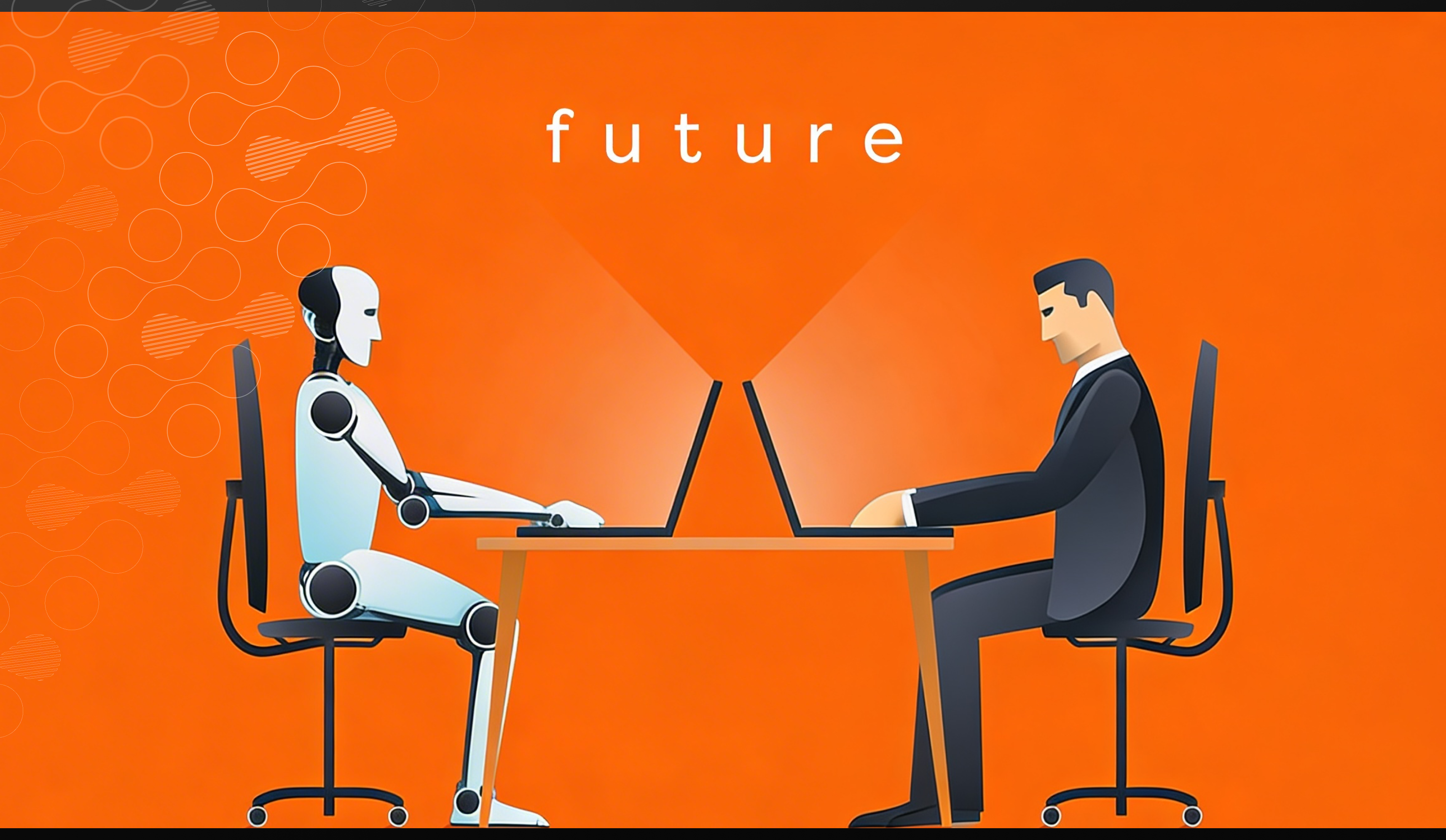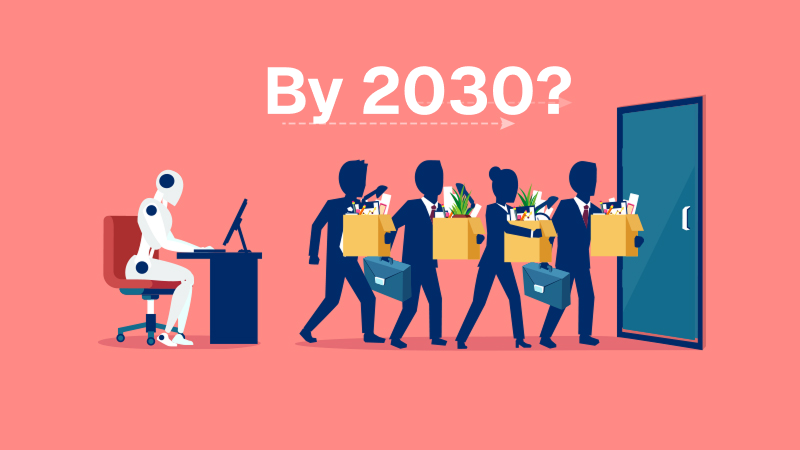
By 2030, Artificial Intelligence is expected to significantly transform — and in many cases automate — large portions of knowledge-based jobs such as coding, software development, graphic design, data analysis, customer support, and administrative work. As AI systems become faster, more accurate, and deeply integrated into business workflows, companies are increasingly relying on automation to reduce costs and increase productivity. While this does not necessarily mean complete job loss, it signals a major shift where traditional roles will be redefined, fewer entry-level opportunities may exist, and professionals will need to adapt to working alongside intelligent AI systems.
AI Could Reshape Jobs by 2030§
Artificial Intelligence is rapidly transforming the global workforce. According to emerging research and early labor-market signals, many knowledge-based job roles may experience significant disruption or partial automation by 2030 as AI systems become more capable and widely adopted.
While mass unemployment has not yet occurred, AI exposure is already influencing hiring patterns, job growth projections, and workforce composition, particularly in highly skilled and digital professions.
This report introduces a new framework for understanding how AI is affecting employment and which occupations may face the greatest long-term transformation.
Introduction§
The rapid spread of AI technologies has triggered a surge in research attempting to forecast labor-market disruption. However, past predictions of technological displacement have often proven inaccurate.
For example:
- Earlier estimates suggested that a quarter of U.S. jobs could be offshored, yet many continued to grow
- Studies on industrial robots have produced conflicting conclusions about employment effects
- The long-term job impact of globalization and trade shocks remains debated
Given this uncertainty, researchers now aim to create better measurement tools to understand AI’s real economic influence before large-scale disruption becomes visible.
Measuring AI Exposure§
This research introduces a task-based framework to evaluate how AI affects occupations.
The approach combines data from three key sources:
- The *ONET database**, which lists tasks across 800 occupations
- Real-world AI usage data from professional environments
- A theoretical capability metric estimating whether AI can double task speed
Tasks are scored as:
- Fully automatable by AI
- Automatable with additional tools
- Not automatable
While many tasks are theoretically feasible for AI, real-world adoption remains limited due to:
- Legal constraints
- Software integration challenges
- Need for human verification
- Organizational resistance
However, theoretical capability and actual usage are strongly correlated, indicating future adoption potential.
Observed Exposure: A New Metric§
The study introduces observed exposure, a measure capturing:
- Whether job tasks are theoretically AI-capable
- Whether those tasks are actually being automated in professional settings
- Whether AI use is augmentative or fully automated
- How much of a job’s time is spent on AI-impacted tasks
This provides a more realistic estimate of AI disruption risk compared to purely theoretical models.
AI Is Still Far From Its Full Potential§
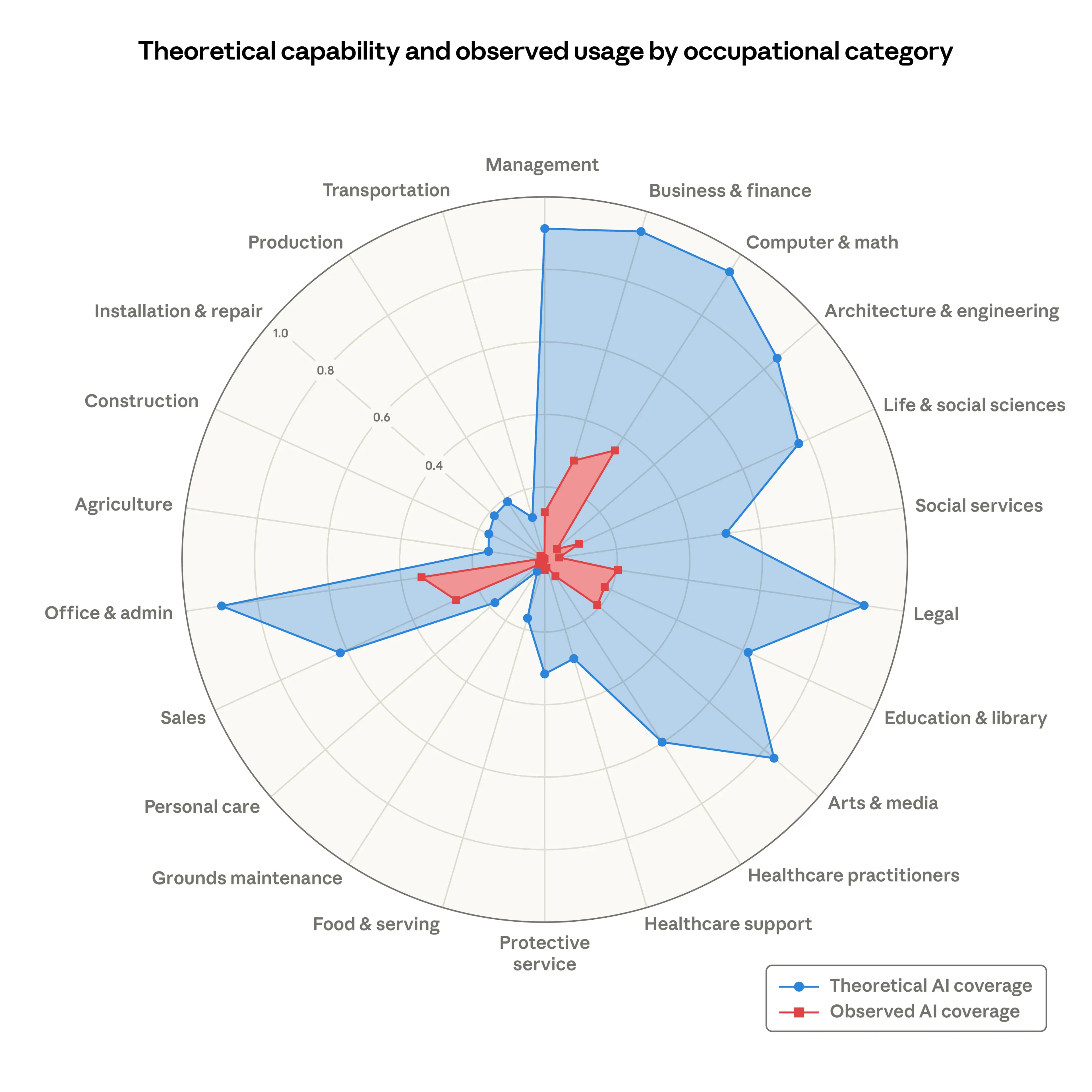
Current data shows that AI usage covers only a fraction of tasks it could theoretically perform.
For example:
- In computer and mathematics roles, AI could potentially impact over 90% of tasks
- However, real-world usage currently covers around one-third
This gap suggests that future adoption could significantly expand AI’s labor-market influence.
Most AI-Exposed Occupations§
The occupations with the highest observed exposure include:
- Computer programmers
- Customer service representatives
- Data entry professionals
- Financial analysts
At the other end of the spectrum, many physical or service-based jobs remain largely unaffected, such as:
- Cooks
- Mechanics
- Lifeguards
- Bartenders
AI Exposure and Job Growth Projections§
Government employment forecasts suggest that jobs with higher AI exposure may experience slower growth over the next decade.
Statistical analysis indicates:
- Every 10% increase in AI exposure corresponds to slightly lower projected job growth
- However, the relationship remains modest and uncertain
This suggests AI may reshape job demand gradually rather than causing sudden mass layoffs.
Workforce Characteristics in AI-Exposed Jobs§
Workers in highly exposed occupations tend to:
- Earn higher salaries
- Have more advanced education
- Be more likely female
- Be more likely employed in knowledge-intensive industries
This highlights the possibility that AI disruption could disproportionately affect white-collar professionals.
Unemployment Trends Since AI Adoption§
Despite growing AI capabilities, there is no clear evidence that AI has increased unemployment so far.
Key observations include:
- Unemployment rates among highly exposed workers remain stable
- Economic shocks like COVID-19 had far larger employment effects
- AI’s labor-market influence may be gradual and difficult to detect in aggregate data
Early Warning Signal: Slower Hiring for Young Workers§
One concerning trend is emerging:
- Workers aged 22–25 are slightly less likely to be hired into highly exposed occupations
- Job entry rates into AI-exposed roles have declined modestly since 2022
Possible explanations include:
- Employers automating entry-level tasks
- Young workers shifting industries
- Increased competition from AI-augmented productivity
This could signal future structural changes in career pathways.
Discussion§
This research represents an early attempt to measure AI’s labor-market impact using real usage data.
Key conclusions:
- AI disruption is real but still emerging
- Highly exposed occupations are evolving rather than disappearing
- Hiring patterns may shift before unemployment rises
- Continued monitoring is essential to identify future economic shocks
As AI capabilities expand, the gap between theoretical automation potential and real adoption will narrow. Understanding this transition will be critical for workers, businesses, and policymakers.
Final Thoughts§
AI is unlikely to eliminate jobs overnight. Instead, it will gradually transform tasks, reshape hiring demand, and redefine required skills.
By 2030, many knowledge-based roles may become:
- Highly automated
- AI-augmented
- Or fundamentally redesigned
Preparing for this shift will require:
- Upskilling
- Adaptation
- Strategic workforce planning
The future of work is not simply about job loss — it is about job evolution in the age of intelligent machines.
FAQ
Will AI take my job by 2030?
Not necessarily—many knowledge-based tasks may be automated, but roles will often be redefined rather than eliminated. Workers who upskill and focus on oversight, strategy, and complex judgment will remain valuable.
Which occupations are most exposed to AI by 2030?
High-exposure roles include computer programmers, customer service representatives, data entry clerks, and financial analysts, where many routine or information-processing tasks can be automated.
How is AI exposure measured in this research?
The study uses an observed exposure metric that combines theoretical AI capability, real-world AI usage, whether tasks are augmentative or fully automated, and the share of job time affected.
Will AI cause mass unemployment soon?
There’s no clear evidence of mass unemployment so far; adoption appears gradual and may first shift hiring patterns—especially entry-level roles—rather than cause immediate large-scale job loss.
How can workers prepare for AI-driven changes?
Prioritize upskilling in areas requiring critical thinking, creativity, and human judgment, learn to work with AI tools, and seek roles emphasizing oversight, integration, and domain expertise.